
Early Brewing.
ALE.
Beer has been brewed in Britain from as early as the first settlers. In 600AD a crude method of ale was brewed from grain and several other ingredients including heather, flowers and plants. It was a form of food and was usually made by the lady of the house in every house hold.
Archeologists have found pottery with traces of calcium oxalate (ale residue) which has been found at three sites in Scotland; Strathallan in Perthshire, Ashgrove in Fife and Machrie Moor in the Orkney Isles. The last two sites are Bronze Age, but the first is Neolithic with artefacts dating from c2600 BC. The ale traces found at Ashgrove and Machrie Moor in Scotland were found to contain immature lime pollen and traces of meadowsweet, suggesting that the ale had been flavoured to produce a primitive ale.
The public today uses the term "Beer" to describe all manner of alcoholic brews, but within the brewing industry, "beer" specifically means ale that has been flavoured with hops, which give the ale a distinctive bitter palate. Since hops were not introduced into Britain until the 15th century, some would say it is incorrect to use the term "beer" for any ale brewed before the 1400s whatever about the niceties, the inclusion of meadowsweet was a good choice, as the herb prolongs the shelf-life of ale by inhibiting fermentation.
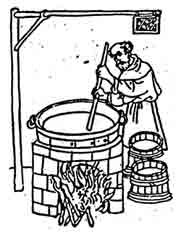 Brewing was practiced by Glasgow Clergy from the 12th century, even before Tennents brewery in Wellpark was even thought of, Glasgow Munks were brewing ale. The Molendinar Burn, was an ideal source of clean water for brewing.
Black Friars (Dominicans) had brew houses on the High Street on the opposite side of the street from the Grey Friars (Franciscans) , their houses were on the west side of the street. These brew houses were well equipped for not only brewing ale but were used for baking bread. Part of Glasgow's daily intake consisted of bread drowned by ale. After the reformation the old brew houses were in a state of disrepair and became derelict.
Home brewing was a domestic chore, early Scotsman were always on the pull for a good wife especially if she could brew a good ale. Small commercial breweries were established in the Drygate, one of Glasgow's oldest streets. The Molendinar burn passed through the Drygate, Gallowgate before ending up in the River Clyde. Molendinar Street off the Gallowgate is a reminder that the burn passed here.
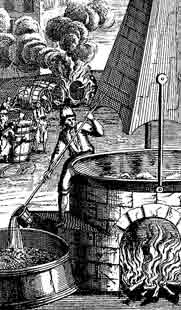 Early Scottish ale had a sweet taste which was flavoured with herbs, plants, heather, including myrtle, ginger, gorse and broom, since hops were unknown at the time. Long after the Englishmen became used to ales made from hops, the Scots continued to sup sweet ale without hops.
The oldest known recipe for ale was found on a c1800 BC clay tablet found at the city of the in modern-day Iraq. The brewing method described is roughly as follows: "Bake cakes out of malted barley break up the cakes and mix with water and strain the resulting sweet-tasting liquor into large jars which should then be left aside to allow fermentation to take place."
In 1574 Glasgow Magistrates fixed the price of strong ale known as the "Kings Ale" at 6d a pint. The Magistrates employed twelve ale tasters to go into all the brew houses in the Glasgow. Tavern Keepers were allowed to sell ale in authorised containers such as a mutchkin. Scots pint was the equivalent of an English quart, while the Mutchkin held an English pint. At the end of the 16th century, hopped beer was first brewed in Glasgow and sold at a cost of 1 shilling 8d a pint. Beers brewed without hops was sold for a few pence cheaper.
In the 1600s Glaswegians were drinking German imported beer known as Mum Bier- spruce beer, along with the locally brewed ale. Drinkers in Glasgow were also getting drunk on French Claret, Spanish "Sack" (sherry and hot water) and aqua vitae (whisky.)
In the 1770s Glesga Punch- a mixture of Jamaican Rum, water, floavoured with citrus fruits as oranges, limes and lemons. Punch was the favourite tipple at all social functions, the punch was usually served in a large hand-painted china bowl.
PORTER
Porter was a tasty new brew that was devoloped in London in the 17th century because of market conditions involving taxation, economies of scale and a growing sophistication of taste among beer consumers. Porter's name is believed to be derived from the fact that porters working in London's markets particularly favoured it. At first it was known as "three thread," because it was originally made from a blend of three different ales- pale ale, mature dark ale and immature dark ale- that were kept in kegs behind a pubs bar counter. In 1722 a London brewer names Ralph Harwood produced a beer that could be supplied in a single barrel., yet which still had the complex aroma and taste of "three thread" porter beer. The fact that the new brew was now supplied in a single keg also made it ideal for export.
In 1787, Arthur Guinness became the first brewer to produce porter, with other Irish brewers following suit, as a result, British beer imports started to decline.
The increased duties on Spirit imposed by the Gin Acts of 1744 and 1751 led to increased beer consumption within the licensed trade, but it also led to a boom in an unlicensed trade in whisky, described as "Poteen" from the 18th century onwards.
End.